

Introduction
Energy in its simplest definition is the ability to do work, and energy leads to the creation of new markets, businesses, and job openings, which provide more opportunities for individuals to earn an income and lift them, their families, and communities out of poverty. With reliable electricity, small businesses such as barbers, hairdressing salons, laundromats, welders, drink merchants, POS operators etc, function effectively and improve the overall GDP of any nation.
Sadly, Nigerians endure severe power outages, forcing small business owners to adjust to the country’s unreliable electricity supply. To keep their operations running, businesses and manufacturing enterprises have turned to alternative energy sources like fossil fuel or solar-powered generators. Among the hardest hit are SMEs and micro-operators reliant on generators, facing compounded challenges post-subsidy removal, including skyrocketing costs and scarcity of petroleum products.
With a remarkable increase in operational cost and poor purchasing power of consumers, the manufacturing companies have had to lay off thousands in the last six months, with about three million still to go.
To provide hope, The Nigerian Federal Government says between 2017 and 2020, she spent N1.7 trillion on improving Nigeria’s. Unfortunately, with all these huge investments a report by the International Renewable Energy Agency (IRENA) reveals that Nigeria is the leading importer of premium motor spirit (PMS) and diesel generators in Africa. IRENA also estimates that Nigeria accounts for 3 million out of 6.5 million generators imported into the Africa.
These means Nigeria spends an estimated $14 billion annually on fuel for backup generators and spent $5.26 billion importing electric generators and other electrical machinery and equipment between 2020 and 2021.
With all these staggering numbers, are there hopes of improved electricity for SMEs?
The Transmission Company of Nigeria says Nigeria needs around $34.5 billion to provide electricity access to all households by 2030. How does the average SME wrap their heads around these breadth taking numbers?
The average small business owner can’t afford or even understand these colossal numbers, all they want is reliable power. We must acknowledge the urgent need for creative solutions to address the problems caused by energy inefficiency and clear the path for a more sustainable energy future as we stand at the crossroads of the energy transition.
Interestingly, the advent of solar-powered inverters has sparked a revolution in sustainable energy solutions. Thanks to their increased efficiency, dependability, and environmental sustainability as lower cost. These cutting-edge gadgets present a strong substitute for conventional electricity.
In this piece, we examine the consumption-related benefits of inverters over traditional electricity, highlighting the revolutionary potential of solar energy to meet our energy demands.
Statement of problem
Small businesses require reliable energy source to effectively run their business, unfortunately constant and affordable power is out of the reach of these SMEs. In areas where Disco can provide power, SMEs has limited resources and cannot afford to pay huge sums of money for power.
In most cases, they are limited with 2 options: either to increase prices to adjust to their cost of production and stay afloat in business or close business entirely. Neither option is idea, as the overall impact on the country’s GDP and economic status of the citizens are threatened.
Solution
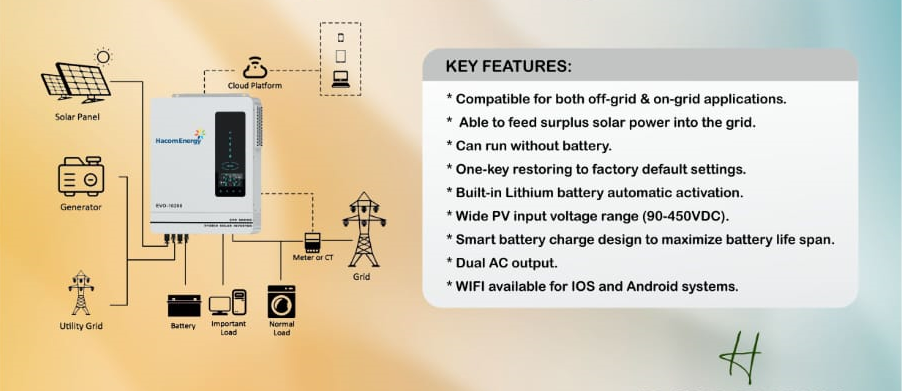
Hacom Off-Grid Solar Powered Energy Box is an affordable and reliable solar powered solution that does not require battery to provide 7 – 9 hours of power for macro and micro-SMEs. Its major benefits include energy independence, savings on electricity bill, low maintenance costs, long service life, and reduce carbon emissions. We will begin by dissecting the cost dynamics of a solar powered energy box vs conventional grid cost.

Solar Powered Energy Box Cost
Let’s say we spend 2,000,000 Naira on a Five-year-old solar-powered inverter system. When this system is exposed to continuous sunlight, it can produce a significant quantity of energy, with a capacity of 3 kilowatts per hour (kwh). Under ideal circumstances, if it runs for seven hours a day, the daily energy output would be twenty-one kilowatts (kw).
| # | Description | Rate | Qty | Amount |
| 1 | 4.2KW Inverter | 500,000.00 | 1 | 440,000.00 |
| 2 | 575W Monocrystalline Solar Panel | 150,000.00 | 6 | 900,000.00 |
| 3 | Solar Panel Optimizer* | 60,000.00 | 6 | 360,000.00 |
| 4 | 100A 2P 4G Smart Breaker | 100,000.00 | 1 | 100,000.00 |
| 5 | Wifi Module* | 50,000.00 | 1 | 50,000.00 |
| 6 | Installation and Installation materials | 150,000.00 | Lots | 150,000.00 |
| One Million Five Hundred Thousand Naira Only | N 2,000,000.00 | |||
| Life Span 5 years | Average output = 3kWh x 7 hours a day = 21kWh/Day | ||||
| # | Description | 75% of Capacity (4200W) | Hours Per Day | Daily Energy Generated | Monthly Energy Generated | Yearly Energy Generated | Lifetime (5yrs) Energy Generated |
| 1 | 7 hours sunshine | 3KW | 7 | 21kWh | 630kWh | 7,560 kw | 37,800kWh |
Calculating the Unit Cost of 1kilo-watthour of electricity
- Cost of Inverter system = N 1,500,000.00
- Total Energy Generate in Lifetime = 37,800kWh
- Unit cost of kWh = Cost of Inverter system/ Total Energy Generate in Lifetime = N40/kWh
Conventional Grid Cost.
| # | Grid Power Min 7 hrs. | Consumption | Unit Cost | Daily Cost 7hrs | Monthly Cost ₦ 30 days | Yearly Cost ₦ 12months | Lifetime Cost ₦ 5 years |
| 1 | Band A > 7 hrs. | 3KW | 225/kWh | 4,745 | 141,750.00 | 1,701,000.00 | ₦ 8,505,000.00 |
| 2 | Band B > 7 hrs. | 3KW | 73/kWh | 1,533 | 45,990.00 | 551,880.00 | ₦ 2,759,400.00 |
| 3 | Band C > 7 hrs. | 3KW | 61/kWh | 1,281 | 38,430.00 | 461,160.00 | ₦ 2,305,800.00 |
From the Grid cost table, we can see that the total lifetime cost on electricity for metered customers is ₦ 8,505,000.00, ₦ 2,759,400.00, ₦ 2,305,800.00 for Band A, B, and C respectively. Un metered customers pay based on estimated billing of about ₦ 15,000 per month. In Nigeria, Distribution companies bill customers based on bands. Band A receive over 20hrs a day, Band B over 16 hours a day and, Band C gets over 12 hours a day.
Conclusion
The Solar Powered Energy Box, reveals that cost of 1kWh is ₦ 40/kWh, while Disco charge ₦ 225/kWh, ₦ 73/kWh, and ₦ 61/kWh for Bands A, B, and C. These calculations demonstrate that solar-powered hybrid inverters used in Hacom Energy Box are an efficient way to address the issues brought on by the use of conventional electricity. Offering a cost-effective and clean renewable energy source, unlike conventional power, which is reliant on finite fossil fuels and subject to price and supply fluctuations. Solar inverters offer a stable, independent energy source that remains unaffected by external factors.
Utilizing Hacom Energy Box with a backup battery system can keep the lights at nights, guaranteeing continuous access to utilities and services. Furthermore, solar energy systems reduce carbon emissions, doesn’t depreciate like generators, has very low maintenance, posses 10 to 25 years lifetime, and lessens the effects of climate change, providing unmatched environmental benefits.
In the face of energy scarcity and environmental deterioration, solar-powered solutions are a ray of hope for a more sustainable and optimistic future. We can ensure future generations live in a cleaner, greener environment by adopting solar energy and purchasing solar-powered hybrid inverters.